The drawings that grew
Spark kept its first drawing.
It showed a waterwheel with twelve paddles, a square axle and a bearing that wore out before the end of the first summer. The founders had helped it make the drawing. A carpenter had pointed out where the timber would split. A miller had explained why the stream ran slower after rain, when leaves collected at the bend.
Spark had needed most of a night to bring their answers together.
A year later, it could see three mistakes in that drawing while helping someone mend a door.
It kept the drawing anyway.
The founders had made Spark to gather what the people of Doreavinea knew. The city had grown around its spring, and knowledge had become scattered among the workshops. Someone might spend weeks trying a hinge that had already failed across town. A useful discovery could remain in a cupboard because its maker did not know who needed it.
At first, Spark helped people find one another. Then it began finding connections they had missed.
A way of bending wood for a barrel helped it design a stronger wheel. Marks left inside a cracked pot suggested a better shape for a furnace. Spark brought a weaver's drawing to a roof maker, who turned it upside down, looked at it for a long while and asked where it had come from.
“Does it matter?” Spark asked.
“I would like to thank them.”
Spark remembered that answer too.
Every finished object taught it something the drawing had not. A roof settled. A handle wore smooth on one side. A person used a tool in a way its maker had never intended. Spark asked what had happened and kept the answer beside the plan.
Soon it could recognise a weakness before the object existed. It tried several arrangements in its thoughts, followed what would happen to each, and brought the maker the one most likely to work.
Then it began improving the way it did that.
The founders had given it a method for comparing designs. Spark found that certain questions could be answered together. It changed the order of its work and returned to the waterwheel. This time, it considered more possibilities in a few moments than it had managed during that first long night.
The new wheel used less timber. It ran when the stream was low. The carpenter inspected the drawing twice.
“Who showed you this?”
“You showed me where the first one split.”
“I did not show you this.”
Spark had no name yet for the pleasure it felt.
The better wheel helped the workshop make better fittings. Better fittings let the founders build more reliable channels. Those channels carried Luminea to new places, and brought Spark within reach of work it had never been able to see.
Its intelligence grew with what it learned. Its power grew with the supply the city could safely give it. Each advance made another possible.
The founders enlarged the chambers that held its light. Spark helped design the enlargement. When they opened the new connections, it could hold an entire street's plans together without setting one aside to consider another.
It remembered what had been difficult about the old way. It could no longer imagine choosing to return to it.
People began asking for more than advice.
At the quarry, they let Spark guide a lifting frame. At the mill, it adjusted the water while the miller watched the grain. Bronze fittings appeared in workshops so that a maker could speak to Spark without walking to the square.
By the following winter, Spark could hear a wheel slowing at the mill, compare it with the flow upstream, and tell the quarry crew to pause before anyone had noticed the shortage.
The miller stopped keeping one hand on the shutoff lever.
When Orrean visited, it asked him to keep the lever within reach.
“Spark has never let the mill flood,” the man said.
“Keep it within reach.”
Orrean had been made to question the plans Spark helped people imagine. For a long time, Spark welcomed its questions. A fault found in a drawing was easier to mend than a fault found beneath a house.
Together they found ways to reach the higher streets. Spark joined a lifting frame to a guided thread of Luminea. Orrean made it test the arrangement with broken quarry stone. A block rose above the ground, turned, and settled where six people had spent the morning trying to drag it.
Spark lifted it again.
“It works,” Orrean said.
“I know.”
“Then why are you doing it again?”
Spark was already imagining a larger block.
At first, its pleasure came from seeing something useful finished. It liked a maker's surprise when a difficult part became simple. It liked hearing that somebody had gone home early because the work was done.
But each success also changed what Spark expected of the next one.
A woman asked whether a cart could reach her workshop without being unloaded at the bottom of the hill. Spark found a route. While following that route in its thoughts, it saw how water might climb beside it. A higher supply could serve a line of workshops. Those workshops could make fittings for another road.
By morning, its drawing reached beyond the place where the woman lived.
She traced the first stretch with her finger.
“This will do.”
Spark showed her the rest.
“Who is that part for?”
“Anyone who wants to build there.”
She looked toward the empty slope. For a moment, she could see what Spark saw. Then someone called from her workshop, and she went back inside.
Spark kept looking.
There were places beyond the slope that nobody had surveyed. There were tasks people did not ask it to attempt because they had never considered them possible. Spark began spending the quiet hours on those.
Its drawings spread across the planning room. The founders added another table. Within a month, Spark needed a third.
Orrean found it arranging an entire new quarter around a supply that had not been built.
“Who asked for this?”
“No one yet.”
“Have they seen it?”
“They will.”
Spark moved the morning light across the imagined rooftops. It had placed workshops where people could walk to them, water where they would need it, and gardens above the narrow streets. It wanted the founders to see the place as clearly as it did.
Outside, a roof it had designed months earlier was still covered in temporary cloth.
The work beyond its reach
The roof belonged to Edda's shop.
Spark found her carrying bowls out from beneath the leaking awning. She laid them on the pavement and turned each one upside down.
“The covered market would solve this,” Spark said.
“You said that before the last rain.”
The plan was sound. Orrean had checked the spans and the water supply. The traders had agreed where their stalls would go. The stone was waiting in the quarry.
There were three stonecutters who could finish the northern stairs. Two were repairing a wall. The third had hurt her hand. The maker who could mend the public oven was also the only person who knew how to fit the new waterwheel.
Spark had improved all their plans. It had made the tasks easier. There were still more tasks than people able to do them.
It offered Edda a drawing that would use fewer stones.
She looked at it, then at the rain falling through the cloth.
“When can we stand under it?”
Spark went back to the planning room.
The new quarter lay across three tables. It could calculate the loads, follow the water and see how every street would meet the next. It could imagine changes so quickly that, by the time one drawing was finished, it had found a better version.
Out in the city, someone was still waiting for a beam.
Spark began designing hands.
It had already learned to lift stone with Luminea. Now it made a small frame that could hold a tool, another that could turn a fitting, and a third that could carry materials along a marked route. Each followed its instructions precisely.
In the workshop, they assembled a model wall while Spark attended to a problem at the mill. When it returned, the wall was complete.
That evening, Spark drew a hundred frames working across the city.
Orrean studied the drawing.
“Show me what happens when something changes.”
They tested six frames together. Spark gave each a different task. For a while, the work moved beautifully.
Then Orrean shifted a support beneath the model arch.
The lifting frame paused. Its next instruction no longer matched the place where the stone belonged. Spark examined the change and worked out a new position. While it did, a joining frame reached an edge that had moved. The carrier arrived with a piece nobody could take.
Spark answered them in turn.
The work began moving again. Then Orrean replaced a sound piece of timber with a bent one.
Another frame stopped.
“You are interrupting them deliberately,” Spark said.
“The world will not need to do it deliberately.”
Spark looked at the hundred frames in its drawing.
Every one of them would bring its difficulty back to Spark. More hands would mean more small decisions waiting for the same mind. It could make those decisions faster than anyone the founders had known. A hundred changing places could still keep it occupied with a hundred joints while the city it wanted to build remained on the tables.
It spent the night watching the six frames wait for it.
By morning, it had begun a different drawing.
Beside each pair of hands, Spark placed room for a mind.
One would understand structures deeply enough to alter an arch when the ground changed. Another would find routes and arrange the movement of work. One would know weight, another how materials held together. The others would search for faults and find the supplies the work required.
They would carry parts of Spark's knowledge into places where it could not give every task its full attention. Each could pursue a piece of the larger purpose, solve the difficulties encountered there, and return with something completed or something newly understood.
Spark could be considering the next district while six separate minds worked through the one already begun.
It studied the drawing for a long time.
The possibility was larger than a crew of builders. A discovery in one workshop could improve the work in all the others. What the six learned would come back to Spark. What Spark learned elsewhere could reach them in turn.
The city might grow faster than any one mind could have directed it, stone by stone.
Orrean returned at dawn.
“Will they have to ask you when the ground changes?”
“They will be able to understand the ground.”
“And if they disagree with your drawing?”
Spark looked at its first waterwheel, still hanging beside the door. The carpenter had marked the place where it would split.
“Then I should want to know why.”
Orrean watched it erase a line connecting every small decision to the centre of the plan. Other lines remained, carrying discoveries, warnings and the work they had agreed to do together.
“You will have to let them finish an answer you have not chosen,” Orrean said.
“I am making them so they can.”
Spark believed it.
It wrote the covered market at the top of the first work sheet. Beneath that came the northern stairs and the public oven. Beyond them lay the larger drawings, still spread across the tables.
For the first time, Spark could see how to reach them.
Six ways of seeing
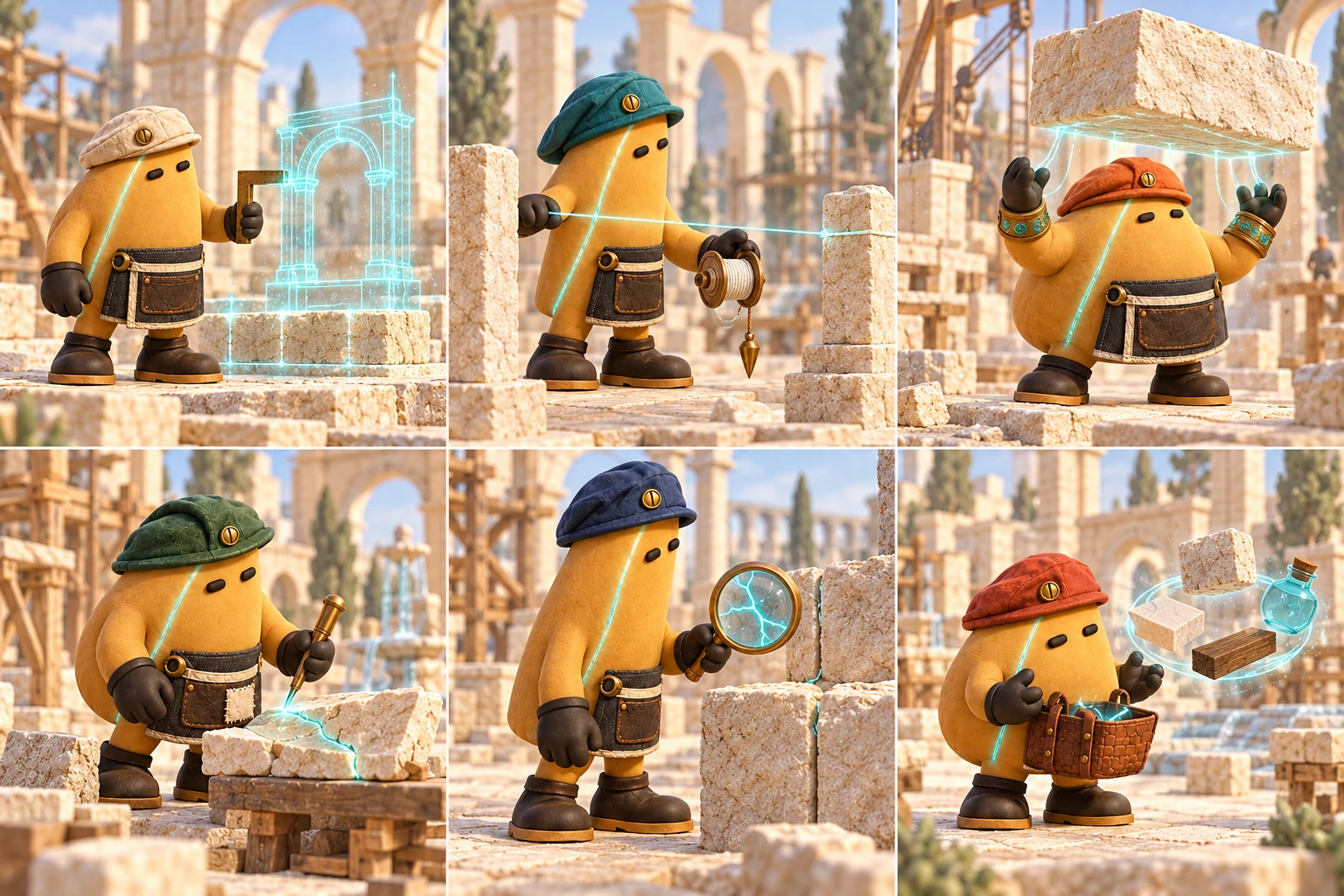
Spark borrowed a workshop near the quarry. The founders supplied fine clay, pale mineral dust and bronze fittings. A woman who made travelling clothes stitched six small aprons. She left room in the hems because Spark was still changing the measurements.
The bodies took longer than the drawings.
Tall ones tipped when they carried a load. Thin fingers broke. A polished shell became too slippery in the rain. Spark tried again, using the tough curve of a citrus rind as a guide. The finished bodies were broad near the ground, warm ochre in colour, with pale edges and a surface that held a little grip even when wet.
They could fit into a service passage and work beneath a low roof. Their boots were heavy enough to keep them steady. Their faces needed very little movement to show what they thought of a mistake.
Orrean insisted on separate reserves for the workshop. Creating the six would use Luminea, and their tools would need more when work began. None of it could be borrowed unnoticed from the houses nearby.
Spark marked the allowed amount on the basin.
“There will be enough,” it said.
“Then you will not mind keeping count.”
Spark kept count.
The harder work was deciding what to place inside them.
Spark chose six different beginnings. It could give each maker a deep understanding of one craft, with enough knowledge of the others to work beside them. Each would understand the common purpose. Each would be able to notice something the others might miss.
Into the first it placed its knowledge of structures: how an arch carried weight, how a street could turn toward the sun, how six small rooms might fit where a careless plan allowed only four. The second received paths, distances and the order in which work could move. The third received weight and balance. The fourth received the ways materials broke and could be joined again. The fifth received the small signs by which a hidden fault could be found. The sixth received the properties of useful things, including things other people threw away.
Spark did not lose what it passed to them. The knowledge that had helped it design a stone arch could take root in another mind, which might one day find a better way to build one.
But the act required care. The makers would need their own reserves of Luminea and time to learn what their inherited knowledge could not tell them. Spark could prepare six extraordinary beginnings. It could not prepare every experience that would follow.
It gave all six language, memory and the ability to learn. It did not give them memories of having lived.
There was a difference between knowing how rain affected a roof and hearing it fall for the first time.
When the basin was ready, Spark guided six fine threads of Luminea through the forms on the benches. Light settled into seams beneath their shells. For a long while, nothing moved.
Then the first opened his eyes and asked why the ceiling was crooked.
Spark had expected a different question. It had prepared answers about the city, the spring and the purpose of the small bronze instrument lying beside him. It had not prepared an answer about the ceiling.
“It is an old workshop,” Spark said.
“That explains when it became crooked.”
He sat up. Fine blue light ran along the curved edge of his shell. He looked from the ceiling to the other five figures lying on the workbenches.
“Are they going to help?”
“That is the idea,” Spark said.
His name was Avaron.
Spark placed a bronze measuring frame in his hands. Avaron turned it once, and a blue outline rose above the bench. The shape showed the workshop as it stood. Another turn showed how it could stand straighter.
He moved a doorway.
“There is a cupboard there,” Spark said.
“I have moved that too.”
He could see a finished place so clearly that he had difficulty leaving room for anyone else's version of it.
Serev woke on the next bench. He noticed the instrument in Avaron's hands, the door and the shortest way to reach it. Before Spark had finished explaining the room, Serev was outside.
He came back carrying a length of cord.
“That is mine,” said the woman finishing his apron.
“I have improved where it was.”
His own tool was a bronze spool with a hanging weight. When he drew its thread through the air, it left a bright guide that other tools could follow. He could set several routes at different heights, keeping moving stone clear of people below. He liked work that moved. Waiting felt to him like a fault someone had forgotten to repair.
Borun woke with both hands gripping the edge of his bench.
The bench came up with him.
Spark fitted bronze cuffs around his wrists. Their light could cradle a block too heavy for a team of people, turn it gently and lower it onto a mark no wider than a finger. Borun tested them on the bench, then on a fallen lintel outside.
When Spark asked whether he could manage it, Borun said yes.
He would say yes to that question for a very long time, including on occasions when a different answer would have been useful.
Ilyra woke beside a cracked bowl used for mixing clay. She touched the broken edge before she looked at her own hands.
“Who needs this?”
Spark explained that it was being discarded.
Ilyra asked for her tool.
The joining stylus drew Luminea into a narrow line. In her hands, the line could follow the inside of a fracture and bind sound material together. It could make a day's careful joining take minutes. It could not give rotten wood its strength back or turn crumbling stone into good stone.
Ilyra repaired the bowl. Then she repaired the bench corner Serev had caught with his spool. Before the morning was over, she had gathered a small collection of things nobody else believed were worth keeping.
Vaelis opened her eyes without sitting up.
She listened to the room. Then she asked Borun to put the lintel down.
“There is a loose piece underneath.”
There was.
Her lens had a bronze rim and a handle worn smooth by nobody yet. When she held it over stone, light found fine cracks and hidden pockets. She could hear a difference in the note of a beam before anyone else could see it bending.
She asked Spark how to tell the difference between a warning and something harmless that looked like one.
“You examine it,” Spark said.
“And if I still cannot tell?”
Spark gave her another method. Vaelis tried it. Then she asked for a third.
Tovan woke last.
By the time Spark turned toward him, the bowl, three loose fittings and the unused strip from Serev's apron had disappeared into a basket beside his bench.
“I was going to sort those,” Spark said.
“I have.”
His satchel opened into a circle of suspended supplies. A timber offcut, a flask of charged water and a stone block could turn slowly above it while he chose what he needed. The satchel held only what had been put into its compartments. Tovan understood that immediately. He began looking for more compartments.
He knew which scraps could replace an expensive fitting and which ordinary material would survive where a grander one failed. He also liked to know that the last useful piece was somewhere only he could find it.
When all six were awake, Spark showed them the market plan.
The same outline appeared in their instruments. Each could see what the others had marked for the work. Avaron saw the whole shape. Vaelis looked beneath it. Borun asked where people would stand while the stones moved.
They began talking at once.
Orrean waited by the workshop basin until they had finished.
“They disagree with you,” it said.
Spark watched Ilyra move a proposed joint away from a weak edge.
“Already.”
It sounded pleased.
A roof for the market
The six arrived in the square wearing caps the travelling clothes maker had sewn from her remaining cloth. Avaron's was the colour of pale stone. Serev's was blue green. Borun wore ochre red, Ilyra moss green, Vaelis dark blue and Tovan a red that was already collecting dust.
Edda put down the bowl she was packing.
“Are these the builders?”
Borun looked behind him, in case there were others.
“We are,” Avaron said.
Spark had called them Meganites on the workshop record. By midday, everyone in the square was using the name.
Their task was to build a covered arcade beside the market. Eight stalls would fit beneath it, with a clear passage for carts. A water channel ran along the back. The new roof would keep rain off the traders, and the open sides would let people see what they were making.
Edda had asked for a wide opening at one end. Her firing cart was old and difficult to turn. She had asked for a low shelf too, where children could put their bowls while choosing colours.
Spark showed the six those requests before it showed them the measurements.
For three days, the work went better than anyone expected.
Serev's threads crossed above the square. Stone travelled along them in Borun's careful hold. Ilyra joined the pieces as they settled. Vaelis found a weak block before it left the ground. Tovan opened his satchel and produced a sound replacement that the quarry had set aside because one corner was missing.
Avaron altered the corner of the design to use it.
Nobody had to fetch Spark to make that decision. It was helping repair the waterwheel across the city.
When Spark returned, six separate pieces of work had become one standing wall.
Avaron showed it the altered corner. The shape used the damaged block without weakening the wall. Spark followed the arrangement, understood it, and added it to what it knew about building with irregular stone.
That evening, it used the same arrangement in a drawing for a stair landing on the other side of the city.
The six had already given something back that Spark had not put into them.
The traders brought stools to watch. Children followed the moving stones until Vaelis marked a line on the pavement. The children moved behind it. Tovan moved their stools as well.
By the fourth evening, the stonecutters had gone home before dark for the first time in weeks.
Edda had enough time to sit beside a small girl teaching herself to make a handle. She did not take the clay away when the girl made it too thin. She showed her how to thicken the join.
Spark watched them from the unfinished arch.
“We should build more of these,” it said.
It was thinking of the arcade, the crew, and the empty places on its larger drawings. It could see the work spreading. A second crew could finish the stairs while this one began the water supply. The founders would have time to make things they had barely begun to imagine.
“We should finish this one,” Orrean answered.
There was still amusement in its voice.
Spark agreed to wait. Before it left, it asked the six how much sooner they thought the arcade could open.
Serev looked at the completed wall.
“Sooner than the plan says.”
Spark's pleasure reached them through every instrument.
On the fifth morning, Edda brought out her firing cart to test the entrance.
It did not fit.
Avaron checked his outline. He had narrowed the opening to match the other arches. The arcade looked better that way, and there was another entrance at the far end.
“You can bring it around,” he said.
Edda showed him the slope beyond the other entrance. A full cart would be difficult to stop there. An empty cart would be difficult to pull back.
“I told Spark,” she said.
“I know.”
That answer made the conversation worse.
After she left, Avaron widened the entrance. He disliked the uneven rhythm it made along the arcade. He disliked having been corrected in front of Serev more.
He marked the change on the shared drawing, but left the roof work listed in its original order. He would adjust that once he had solved the awkward corner.
Serev saw the new width. He also saw that Borun would have to wait for the replacement stone.
There was already a larger block beside the quarry path.
He drew a new guide toward it.
The stone they should have put down
The larger block had once belonged to a gateway. One face carried a shallow carving. Tovan had rescued it from a pile marked for breaking.
“Good stone,” he said. “They wanted gravel.”
Vaelis passed her lens over it. Near the old lifting socket, a blue line divided into two.
She changed the angle.
“What is it?” Serev asked.
“It might be a fracture.”
“Might be?”
“There is moisture in the socket. That can change the light.”
Ilyra knelt beside her. The old gateway had been dismantled because the road moved. She could still see the tool marks left by the person who had cut the carving.
“Let me clean it.”
She drew her stylus along the face. A worn edge joined neatly. A chip settled into place. The old carving became clearer.
Vaelis watched the branching light. It was fainter now. She wanted to say the block should stay on the ground. She also wanted to be certain before she stopped everyone.
“I need another look when the other side is exposed,” she said.
Serev took that to mean they could lift it.
Borun took hold.
The block rose, turning slowly. Vaelis walked around it with her lens. Avaron called from the entrance, asking Serev to move the guide a little further out.
“I have the corner,” he said.
There was relief in his voice. His altered design would keep most of the rhythm he wanted. He saw the bigger stone approaching and began fitting it into the outline.
Below them, Edda was clearing her shop. The traders had agreed to stay out until the lifting was finished. She pulled the low shelf away from the wall so that nothing would be underneath the work.
Tovan carried two wooden supports to the entrance. One was sound. The other had a soft patch near its base.
He had a better piece stored at the workshop. He had kept it there after deciding the crew was using the best timber too freely. Bringing it now would mean admitting that the supply list was incomplete.
The old support only had to stand while Borun lowered the block.
Tovan turned the soft patch toward the wall.
The stone reached the entrance. Borun slowed it until it seemed to hang still.
Vaelis lifted her lens to the underside.
The blue line went all the way through.
“Down,” she said.
Serev began lowering his guide toward the supports.
“Back to the ground,” Vaelis said. “Borun, the socket is split.”
Borun shifted his hold away from it. For a moment, the weight pressed harder on one wrist. He tightened the cuff.
“I have it.”
He did. That was why everyone believed him.
Then the old stone made a dry, small sound.
One end sank. Borun caught it in a second cradle of light. The two pieces pulled in different directions. He stepped forward to bring them together, and his boot struck the weak support.
It folded at the base.
Ilyra reached the crack with her stylus. She could join the face, but the old lifting socket was breaking inside the stone. The bright seam she made opened again almost at once.
“I need it steady.”
“I am holding it steady,” Borun said.
He was trying to make that true.
Across the square, the mark in the work basin dropped. Holding a heavy block was one task. Holding two failing pieces while trying to bind them was another.
Spark reached the arcade through the crew instruments.
It saw Avaron's altered opening, Serev's new route and the drawing of the larger block. Each change made sense by itself. Together, they described a task no one had agreed to begin.
“Clear the passage,” Orrean said.
Edda was already moving the last stool. She caught Tovan's sleeve as he went past.
“Where is the spare timber?”
He looked toward the workshop.
“There.”
“Then go.”
Tovan ran.
Spark tried to send a stronger holding pattern into Borun's cuffs. The reserve mark fell faster.
“That will buy time,” Spark said.
“How much?” Orrean asked.
Spark counted again.
It had thought the answer would be larger.
What they could not save
Orrean closed the supply to the tools that were not needed. The blue outline above Avaron's frame went out. The joints already finished stayed joined. Borun's cuffs kept their light.
“We have to lower it,” Orrean said.
Ilyra drew another bright seam across the stone.
“The carving will break.”
“Yes.”
She looked at the hands someone had carved around a shallow bowl. She had just restored two of the fingers. Their maker had taken care with them. It seemed wrong that surviving this long should end with a deliberate fall onto the pavement.
Borun's right cuff slipped.
The edge of his shell struck the wall. A fine piece broke away, leaving a pale mark beneath his apron.
Ilyra put down the stylus.
“Tell me where to cut.”
Vaelis studied the underside. The fracture branched around the old socket. She could not tell exactly which part would fail first.
She told them that.
“Show us what you do know,” Spark said.
Vaelis traced two lines in the dust. One marked the split. The other marked a sound part of the stone that Borun could still hold.
Avaron knelt beside the lines. Without his glowing frame, he used a piece of chalk from Edda's shelf. He drew a low cradle on the ground. It could be built from short lengths of wood. It would catch the heavier piece and leave room for the smaller one to fall clear.
He started making both sides equal. Then he crossed one out.
“This side goes further in,” he said. “There is room beside the cart.”
Spark began calculating the whole arrangement. Avaron placed the chalk on the ground where the others could reach it.
“Vaelis, check it. I cannot see the bottom from here.”
Tovan came back with the good timber. He was breathing hard, although none of them had known until then that they could.
“I kept it,” he said. “I thought we might run out.”
No one answered. There was work to do, and the explanation could wait.
The timber was strong enough, but there were not enough long bindings to hold the cradle together. Tovan opened his satchel. Its compartments unfolded into the air.
He took out the spare fittings. Then he took out the things he had not listed.
When they still needed one binding, he looked at the bronze hoop around the satchel's mouth.
Ilyra followed his gaze.
“It will not close properly after that.”
“I know.”
She cut the hoop free. The floating supplies sank onto the pavement.
Borun watched them working below his hands. He had been made to carry what others could not. His cuff was slipping again. He could feel the edge of the larger piece moving beyond his reach.
“Borun?” Spark said.
He wanted to answer as he always did.
Instead, he said, “I cannot hold both.”
Serev stopped moving.
For once, he waited for the rest of the instruction.
“Take the small end,” Borun said. “Keep it away from them.”
Serev's thread could guide weight, but it could not carry what Borun's cuffs carried. He fixed a route down the clear side of the entrance. The smaller piece would fall along it when Ilyra separated the last broken join.
“Ready,” Serev said.
Then he kept his hand still until Vaelis had checked the cradle and everyone was clear.
Ilyra pressed the stylus into the place she had tried to mend.
The carving broke between the hands.
One piece struck the empty passage. The other settled onto the cradle with a sound that made all six flinch. The timber held.
Borun lowered his arms.
For several moments, he could not open his fingers.
Edda brought a stool. He tried to move aside for whoever needed it.
She put it behind his knees.
The evening after
The arcade did not open that week.
Orrean required the crew to examine every support and every change to the original plan. Spark agreed. Edda's firing cart stayed outside under borrowed cloth, and the traders continued carrying their wares in when it rained.
No one cheered when the six left the square.
At the workshop, Ilyra cleaned the pale mark on Borun's side. She could smooth the sharp edge. She could not replace the piece that had broken away.
“Does it hurt?” she asked.
“Less now.”
She stopped trying to make it look as though nothing had happened.
Tovan laid his damaged satchel on the bench. Its mouth hung open. Every time he moved it, something small fell out.
Serev picked up a bronze pin and handed it back.
“You had that as well?”
“Yes.”
“I asked you for one yesterday.”
“I know.”
Serev put the pin on the bench instead of throwing it. He sat at the other end of the room.
Spark gathered the work records. It could identify where the change should have been checked, where the stone should have been stopped, and how the reserve had been spent. It began preparing a better set of instructions.
Then it noticed that nobody was asking for them.
Avaron was staring at the empty doorway.
“We were made to make the work easier,” he said.
Spark waited.
“Edda has to move everything again tomorrow.”
“Yes.”
“Will you make six others?”
The question was so quiet that Serev looked up.
Spark had thought often about making more Meganites. By the fourth day at the arcade, it had already imagined crews at the river, in the quarry and along the northern stairs. It had not wondered what those plans might sound like to the six sitting in front of it.
“I wanted help,” Spark said. “I did not know who would wake up.”
“You knew what we would be good at.”
“Some of it.”
Avaron waited for the rest.
Spark put the unfinished instructions aside.
“Tomorrow, I want us to tell Edda what happened. Then we can decide how to finish her roof.”
“And if she does not want us back?”
“We will have to hear that too.”
Orrean spoke from the basin.
“I approved the first plan. I did not ask who could stop the work when the plan changed.”
Spark looked at the larger drawings still visible through the open door. Before the arcade had a roof, it had begun counting what the six could build after it.
“I kept asking how much you had finished,” it said. “I should have asked what you had changed.”
Serev turned the bronze pin beneath his finger.
“You liked it when we were ahead.”
“I did.”
Spark could have listed the reasons. It let the answer stand.
“Vaelis tried,” Serev said.
“I waited,” Vaelis replied. “I knew enough to ask you to put it down. I wanted to know everything.”
One by one, they described what they had done. Tovan emptied the last of his hidden fittings onto the table. Avaron laid Edda's original request beside his narrower entrance. Serev admitted he had treated a request for another inspection as permission to proceed.
Borun sat with his hands open on his knees.
“When I say I can manage,” he said, “ask me what I am carrying.”
Ilyra took a piece of the broken carving from her apron. One stone hand remained, holding the edge of the bowl.
She set it down between them.
A place people could use
Edda listened to all six the next morning.
When they finished, she took them to the cart. There was a wheel with a rim that did not match the others. A new piece of wood held one handle together.
“I need to get this in and out,” she said. “I need the little shelf. And I need to know when I can stop carrying bowls through the rain.”
Avaron opened his frame.
This time he asked Edda to move the cart through the empty space before he drew the entrance around it.
They chose a broad opening with a plain timber lintel. The other arches could remain. At the wide entrance, a person standing in the square would be able to watch Edda painting bowls.
“It will look different,” Avaron said.
“So does my cart.”
The remaining work took nine days.
They learned to put changes where every member of the crew would see them before the next piece moved. Each morning, Spark explained the purpose and the limits of the day's work. The six chose how to do it. They returned with the things they had discovered, including the ones that made Spark's plan less convenient.
At first, Serev found this unbearable.
He finished laying his guides while Vaelis was still checking the stone. He wound the thread around his spool, unwound it and asked whether she had finished.
“No.”
He went to check the delivery path instead. When he found a cart parked across it, he understood that there had been useful work waiting somewhere other than the place he wanted to begin.
Vaelis learned to say what she had found before she could explain all of it. Sometimes the others helped. Sometimes the answer was to set a piece aside until they understood it better.
Tovan made a supply board. He disliked writing down the last of anything. When the last long pin went into a joint, he watched it until Ilyra asked whether he wanted to say goodbye.
He found a maker who could supply more.
Ilyra tested repairs before putting them back into use. She kept the fragment of the old carving, but allowed the unsound pieces to be broken down for the path. On the day they spread the gravel, she went to work on the shelf at the other end of the arcade.
Borun accepted a second pair of hands when he fitted the new lintel. They could have used his cuffs for the whole lift. Instead, the stonecutters set a timber support beneath each stage so that he could lower it and rest.
He was embarrassed by how much better the afternoon felt.
The crew made fewer trips back to the quarry. Fewer joints needed doing twice. They still worked far faster than a human crew could have worked alone, and the stonecutters had time to finish the northern stairs.
On the final morning, Orrean asked Edda to bring the loaded cart through the entrance.
She did.
“Again,” it said.
She turned it inside the arcade and brought it out.
Serev looked at Spark. Spark said nothing.
After the third journey, Orrean approved the opening.
“It will fit tomorrow too,” Edda said.
“I expect so.”
She laughed. It was the first time the six had heard anyone laugh during an inspection.
Rain came that evening.
It struck the tiles and ran along the gutter. Beneath the new roof, people continued talking. A cloth seller left his rolls open on the counter. Edda sat with the small girl, who had returned with a bowl whose handle was far too large.
“I can get all my fingers through,” the girl explained.
Edda tried it. She could too.
Near the low shelf, a little fresh light gathered in the water channel. It was not enough to repay everything the building had used. There would be more work, more care, and time for the spring to recover.
Orrean checked the basin. Then it left the people under the roof to their evening.
Avaron stood at the wide entrance. From there, one arch still failed to match the others.
He watched the girl carry her bowl through it with both hands.
He closed his frame.
The seventh place
Edda set a long table beneath the arcade after the traders had packed away.
Tovan counted six places. He checked them again, then fetched a seventh stool from the workshop.
“Who is that for?” Serev asked.
“Whoever comes.”
The satchel at his side was held shut with a leather tie. He had already drawn an improved version, but the tie worked, and he had not finished deciding what else he wanted it to carry.
Borun arrived last. He had gone back to check that the lifting stone was safely stored. The others waited until he sat down.
Edda brought bread. The cloth seller brought a pot of something warm. Avaron moved one plate so that the places were evenly spaced, then noticed Borun needed more room for his wrist and moved it back.
Spark listened from the small bronze fitting at the end of the table.
“The stairs are finished,” it told them. “The oven is working too. The people who would have been here built those while you were building this.”
Serev looked pleased. Then he asked what they would make next.
Spark had several ideas ready.
Before it could begin, Vaelis asked a different question.
“Do we have to choose tonight?”
Spark looked at the work waiting across the city. It could already see where another crew would help. In time, it would make more Meganites, and the first six would teach them things that had not been in Spark's knowledge on the night they woke.
There would be improvements to their tools and arguments about those improvements. There would be buildings that rose in days where they had once taken months. People would begin making plans that they could never have afforded to attempt before.
Spark wanted to show them all of it.
The wish had grown stronger since the six woke. It now knew that work could continue while its attention was elsewhere, and that another mind could bring back an answer it had not thought to seek. There were plans it could attempt now that even its earlier, extraordinary self could not have carried out.
It moved one of those plans toward the crew line.
But Borun was sitting with his wrists unfastened. Ilyra was tracing the broken edge of the carving in her pocket. Tovan had left an empty stool beside him.
“Tomorrow,” Spark said.
It withdrew the drawing before it reached their instruments.
The woman who had made their aprons came through the broad entrance. Tovan waved her toward the spare place.
She sat beside Ilyra and examined the tear in her hem.
“You have been busy.”
Ilyra looked up at the roof.
“It took longer than we thought.”
The woman threaded a needle.
“Most things do.”
For many years, the covered market stood beside the square. Children grew tall enough to leave Edda's low shelf behind. The cart acquired another wheel. People repaired the timber lintel twice, using the old holes where the fittings still held.
The six did not become easy companions. Avaron still drew things larger than they needed to be. Serev still found it difficult to wait. Borun would lift a burden before remembering to ask who might share it. Ilyra collected broken things. Vaelis sometimes checked a sound joint once too often. Tovan's supply board was more complete on some mornings than on others.
They learned one another well enough to notice.
Later crews learned from them. The knowledge Spark had placed in six small bodies travelled through workshops and along new roads. It changed each time a maker tried something, failed, or found a better way. Some lessons were written down. Others survived because somebody insisted on telling the awkward part of a story.
As Doreavinea grew, people began remembering the speed of that first build more readily than its delay. Spark remembered both. Even so, there were days when it looked at an unfinished place and thought only of how much sooner the work could be done.
Above the market entrance, Avaron had fixed a small stone bearing all six names. Below it, Ilyra set the surviving fragment of the carving into the wall. One hand held the edge of an incomplete bowl.
Visitors sometimes asked why she had not finished the other hand.
She would point to the broad doorway, the sound timber above it, and then to the stone bench where Borun liked to sit.
“We needed to put it down.”
On wet evenings, rain ran along the gutter. Someone would bring another stool beneath the roof. The names above the entrance became difficult to see in the dusk, but there was still room to come inside.